Exterior Fiber Optic Cable: The Robust Backbone of Digital Connectivity

2026-01-05

image.png

In today’s digital era, everything from video streaming and cloud computing to remote work and smart city development relies on high-speed, reliable data transmission. The critical component that makes this possible—carrying massive data flows between buildings, across cities, and even between continents—is the exterior fiber optic cable. It is rightly known as the "information superhighway" and the "rugged nervous system" of the digital world.


What is an Exterior Fiber Optic Cable?


An exterior fiber optic cable is a type of fiber cable specifically engineered for installation and operation in outdoor or harsh environments. Unlike indoor cables designed for controlled climates, exterior cables must withstand ultraviolet radiation, extreme temperatures (freezing and scorching), rain, moisture, chemical exposure, rodent/insect attacks, and mechanical stress such as impact and crushing.

At its core, it contains one or multiple extremely thin strands of glass or plastic fiber that transmit data using light pulses. This technology offers unparalleled advantages: immense bandwidth, very low signal loss, immunity to electromagnetic interference, and long-distance transmission capabilities.


Key Construction and Types of Exterior Fiber Cables


To endure harsh conditions, exterior cables feature a sophisticated multi-layer design:


  1. Fiber Core: The central element that carries the light signal.

  2. Buffer/Coating: Provides primary mechanical protection directly around the fiber.

  3. Strength Members: Typically aramid yarns or fiberglass rods that bear the tensile load, preventing the fragile fibers from being stretched and broken.

  4. Water-Blocking Elements: Use of water-blocking tapes, yarns, or gels to prevent longitudinal water penetration, which is critical for long-term reliability.

  5. Outer Jacket: The cable's armor. Made from high-quality polyethylene, it offers excellent UV resistance, weather ability, abrasion resistance, and corrosion protection. The jacket is often black or with UV-stabilized pigments.


Main Types of Exterior Fiber Cables:


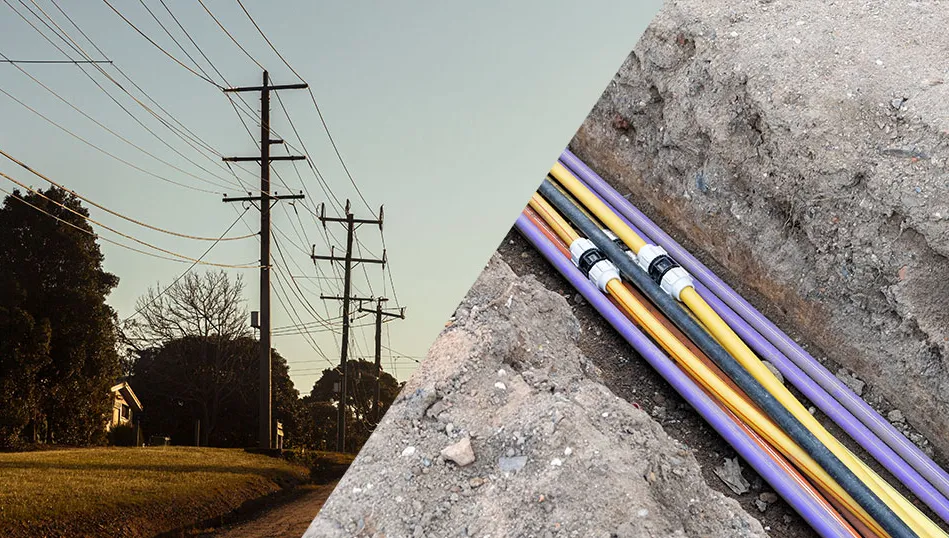
  • Aerial Cables: Designed to be suspended on utility poles or towers. They often include an integrated messenger wire (steel or alloy) for support and tension bearing. They require high tensile strength and resistance to wind vibration.

    (Illustration: Exterior Aerial Fiber Cable with messenger on a pole)

  • Direct-Burial Cables: Installed directly in the ground within ducts or trenches. They have a tougher, thicker jacket and are often armored with corrugated steel or aluminum tape to resist soil pressure, rock impingement, and rodent bites.

    (Illustration: Exterior Direct-Burial Cable with metal armor protection)

  • Duct Cables: Placed into pre-installed underground conduits by blowing or pulling. They have a smooth, low-friction jacket for easier installation over long conduit runs.

  • Submarine/Underwater Cables: The most technologically demanding type, used for crossing rivers, lakes, and oceans. They feature multiple layers of armor (e.g., steel wires), heavy polyethylene sheathing, and special waterproofing to withstand immense pressure, fishing trawls, and anchor strikes.
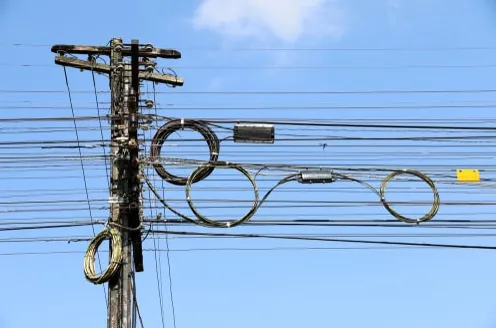
image.png


Core Advantages and Applications of Exterior Fiber Cables


Advantages:


  • Superior Durability: Designed for outdoor service life exceeding 25 years.

  • Long-Distance Transmission: Low signal attenuation allows for spans of tens to hundreds of kilometers between repeaters.

  • Immense Capacity: A single fiber can carry terabits of data, far beyond the capability of copper cables.

  • High Reliability: Immune to EMI, ensuring stable signal quality for critical communications.

  • Enhanced Security: Fibers don't radiate signals, making them very difficult to tap, and physical intrusion is easily detected.


Application Scenarios:

  • Telecom Backbone Networks: Connecting cities and countries at the core network level.

  • FTTH (Fiber-to-the-Home) Access Networks: The "last mile" outdoor connection from the splitter to buildings or homes.

  • Mobile Backhaul: Connecting 4G/5G cell towers to the core network.

  • Enterprise Private Lines & Campus Networks: Interconnecting geographically separate office buildings or campuses.

  • Intelligent Transportation & Security Systems: Providing high-speed links for traffic cameras and signal control.

  • Utility & Energy Networks: Used for communication and monitoring in power grids (often as OPGW or ADSS cables mounted on power lines).


Selection and Installation Considerations


  1. Environmental Assessment: Determine if the installation is aerial, direct-burial, or in conduit. Assess UV exposure, temperature range, and potential mechanical hazards.

  2. Cable Construction Choice: Select the appropriate jacket material and decide if armor or a messenger wire is needed based on the assessment.

  3. Fiber Type & Count: Choose between Single-Mode fiber (for long-distance, high-capacity) or Multimode fiber (for short-distance). Select sufficient fiber count for current and future needs.

  4. Professional Installation: Installing exterior cables requires specialized tools and techniques: proper tension control for aerial deployment, correct burial depth and warning tape for direct-burial, and waterproof sealing for splice closures. Adherence to industry standards is mandatory.

  5. Testing & Acceptance: Post-installation testing with an OTDR is essential to verify link loss meets specifications and all splices are sound.


The exterior fiber optic cable is the unseen yet omnipresent hero of modern communication infrastructure. It silently traverses mountains, crosses oceans, and weaves through cities, carrying the daily digital torrent of our global society. With the expansion of 5G, gigabit broadband, and the Internet of Things, the demand for high-performance, reliable exterior fiber optic cables will only intensify. Selecting the right cable and deploying it professionally is a critical step in building a resilient foundation for our future digital world.


Product Inquiry

We use cookie to improve your online experience. By continuing to browse this website, you agree to our use of cookie.

Cookies

Please read our Terms and Conditions and this Policy before accessing or using our Services. If you cannot agree with this Policy or the Terms and Conditions, please do not access or use our Services. If you are located in a jurisdiction outside the European Economic Area, by using our Services, you accept the Terms and Conditions and accept our privacy practices described in this Policy.
We may modify this Policy at any time, without prior notice, and changes may apply to any Personal Information we already hold about you, as well as any new Personal Information collected after the Policy is modified. If we make changes, we will notify you by revising the date at the top of this Policy. We will provide you with advanced notice if we make any material changes to how we collect, use or disclose your Personal Information that impact your rights under this Policy. If you are located in a jurisdiction other than the European Economic Area, the United Kingdom or Switzerland (collectively “European Countries”), your continued access or use of our Services after receiving the notice of changes, constitutes your acknowledgement that you accept the updated Policy. In addition, we may provide you with real time disclosures or additional information about the Personal Information handling practices of specific parts of our Services. Such notices may supplement this Policy or provide you with additional choices about how we process your Personal Information.


Cookies

Cookies are small text files stored on your device when you access most Websites on the internet or open certain emails. Among other things, Cookies allow a Website to recognize your device and remember if you've been to the Website before. Examples of information collected by Cookies include your browser type and the address of the Website from which you arrived at our Website as well as IP address and clickstream behavior (that is the pages you view and the links you click).We use the term cookie to refer to Cookies and technologies that perform a similar function to Cookies (e.g., tags, pixels, web beacons, etc.). Cookies can be read by the originating Website on each subsequent visit and by any other Website that recognizes the cookie. The Website uses Cookies in order to make the Website easier to use, to support a better user experience, including the provision of information and functionality to you, as well as to provide us with information about how the Website is used so that we can make sure it is as up to date, relevant, and error free as we can. Cookies on the Website We use Cookies to personalize your experience when you visit the Site, uniquely identify your computer for security purposes, and enable us and our third-party service providers to serve ads on our behalf across the internet.

We classify Cookies in the following categories:
 ●  Strictly Necessary Cookies
 ●  Performance Cookies
 ●  Functional Cookies
 ●  Targeting Cookies


Cookie List
A cookie is a small piece of data (text file) that a website – when visited by a user – asks your browser to store on your device in order to remember information about you, such as your language preference or login information. Those cookies are set by us and called first-party cookies. We also use third-party cookies – which are cookies from a domain different than the domain of the website you are visiting – for our advertising and marketing efforts. More specifically, we use cookies and other tracking technologies for the following purposes:

Strictly Necessary Cookies
These cookies are necessary for the website to function and cannot be switched off in our systems. They are usually only set in response to actions made by you which amount to a request for services, such as setting your privacy preferences, logging in or filling in forms. You can set your browser to block or alert you about these cookies, but some parts of the site will not then work. These cookies do not store any personally identifiable information.

Functional Cookies
These cookies enable the website to provide enhanced functionality and personalisation. They may be set by us or by third party providers whose services we have added to our pages. If you do not allow these cookies then some or all of these services may not function properly.

Performance Cookies
These cookies allow us to count visits and traffic sources so we can measure and improve the performance of our site. They help us to know which pages are the most and least popular and see how visitors move around the site. All information these cookies collect is aggregated and therefore anonymous. If you do not allow these cookies we will not know when you have visited our site, and will not be able to monitor its performance.

Targeting Cookies
These cookies may be set through our site by our advertising partners. They may be used by those companies to build a profile of your interests and show you relevant adverts on other sites. They do not store directly personal information, but are based on uniquely identifying your browser and internet device. If you do not allow these cookies, you will experience less targeted advertising.

How To Turn Off Cookies
You can choose to restrict or block Cookies through your browser settings at any time. Please note that certain Cookies may be set as soon as you visit the Website, but you can remove them using your browser settings. However, please be aware that restricting or blocking Cookies set on the Website may impact the functionality or performance of the Website or prevent you from using certain services provided through the Website. It will also affect our ability to update the Website to cater for user preferences and improve performance. Cookies within Mobile Applications

We only use Strictly Necessary Cookies on our mobile applications. These Cookies are critical to the functionality of our applications, so if you block or delete these Cookies you may not be able to use the application. These Cookies are not shared with any other application on your mobile device. We never use the Cookies from the mobile application to store personal information about you.

If you have questions or concerns regarding any information in this Privacy Policy, please contact us by email at . You can also contact us via our customer service at our Site.