

 Español
 Português
 لالعربية
 Русский
 Bahasa Indonesia
 Français
 Türkçe
 Bahasa Melayu
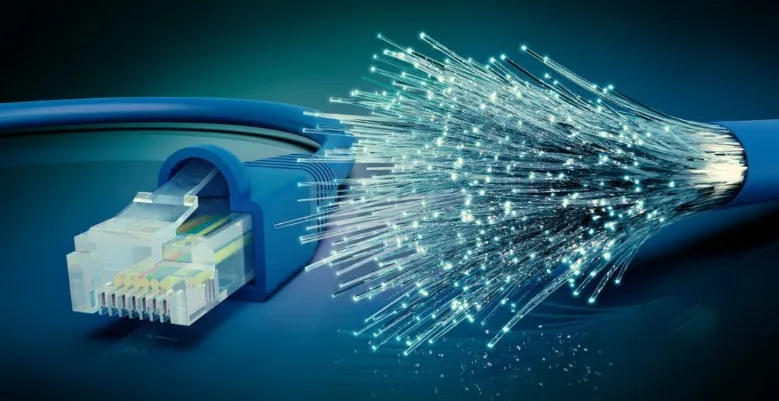
What's the difference between regular network cables and fiber optic cables?
Network transmission media is commonly referred to as network cables. As we all know, there are three main types of network transmission:
1. Coaxial cable; 2. Network cable; 3. Fiber optic cable vs. regular network cable:
Differences between fiber optic cables and network cables
1. Different properties: Fiber optic cables and network cables differ in properties, but fundamentally, they are distinct. Fiber optic cables are an abstract concept, representing the transmission rate of dynamic information; while network cables are a medium, a carrier for information transmission.
2. Different functions: Fiber optic cables are used to accelerate the transmission of various network information; while network cables are used to connect devices, improving the efficiency of network information transmission between them.
3. Different forms of existence: They previously existed in different ways. Fiber optic cables existed in a virtual form, without a physical object; while network cables are tangible, concrete cables.
How to reconnect a broken fiber optic cable?
1. When connecting fiber optic cables, connect them in order: cables of the same color and core, from largest to smallest.
2. When making connections, strip the optical cable. Be careful not to damage the bundle tube. After stripping about 1 meter, some grease will appear inside. Wipe it off with toilet paper.
3. Strip the optical fiber and insert it into the splice box, securing and tightening it.
4. Pass the optical fiber through the heat shrink tubing.
5. Turn on the power and perform the splicing with the fusion splicer. Be careful to avoid dust and fiber optic powder falling into the splicer.
Application Scenarios of Fiber Optics and Network Cables
1. Application Scenarios of Fiber Optics: Fiber optics are primarily used for broadband communications, providing users with interactive multimedia information such as video, graphics, communication, and data. Examples include video conferencing, online interactive games, and remote video surveillance.
2. Application Scenarios of Network Cables: Network cables are used to connect devices and are primarily used for engineering cabling, network connectivity, and connecting device port systems. Examples include switches, hubs, firewalls, and other devices. Transmission speeds of fiber optic and network cables:
Category 7, the best network cable, has a transmission frequency of at least 500 MHz, more than twice that of Category 6 and Category 6a cables, and can reach transmission speeds of up to 10 Gbps.
Fiber optic cable is currently the fastest transmission medium, capable of 40G-100G.
Transmission distances of fiber optic and network cables:
The theoretical transmission distance of a network cable is only within 100 meters; the transmission distance of fiber optic cables: 100Base-FX single-mode modules use single-mode fiber to transmit 10-20 meters.
The differences between ordinary network cables (often called twisted pair cables) and optical fiber can be summarized as follows:
| Feature | Network Cable (Twisted Pair) | Optical Fiber (Fiber Optic) |
| Nature | A medium (or carrier), the physical carrier for information transmission. | An abstract concept, representing the transmission rate of dynamic information. |
| Function | Used to connect devices and improve the efficiency of network information transfer between them. | Used to accelerate the transmission of different network information. |
| Form/Existence | A tangible cable, existing as a concrete object. | Exists in a virtual manner, with no (virtual) physical object (though the fiber optic cable itself is physical). |
| Transmission Rate | The best is Category 7 (Cat.7), with speeds up to 10 Gbps. | Currently the fastest transmission medium, capable of 40G to 100G. |
| Transmission Distance | Theoretical transmission distance is within 100 meters. | Much longer (e.g., 100BASE-FX single-mode modules using single-mode fiber can transmit 10-20 km). |
| Application Scenarios | Used to connect devices; mainly for engineering wiring, network connections, and connecting equipment ports. E.g., connecting switches, hubs, firewalls, etc. | Primarily used for broadband communication, providing interactive multimedia information such as video, images, communication, and data. E.g., work meeting videos, online interactive games, remote video surveillance. |


