

 Español
 Português
 لالعربية
 Русский
 Bahasa Indonesia
 Français
 Türkçe
 Bahasa Melayu
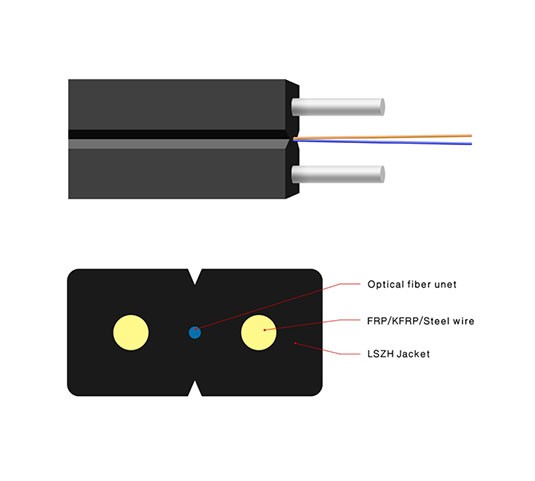
Indoor cables:
The classification of fiber optic cables into Indoor Fiber Cables and outdoor types is primarily determined by their operating environments. Indoor cables are tailored for internal applications, in contrast to outdoor cables, which are engineered to withstand a distinct set of external challenges.
Indoor Fiber Cables are constructed through a precise process using optical fibers as the transmission medium. Their primary components include the glass fibers themselves, protective plastic buffer tubes, and an outer plastic jacket. Since these cables contain no precious metals such as gold, silver, copper, or aluminum, they generally hold no recycling value.
An Indoor Fiber Cable is a type of communication line in which a specific number of optical fibers are bundled to form a cable core, which is then encapsulated with protective sheaths or jackets to enable the transmission of optical signals.
Indoor Fiber Cables offer greater portability and cost-effectiveness, which comes as a trade-off for their relatively lower tensile strength and less robust protective sheathing. They are primarily suited for in-building wiring and the interconnection of network devices.
Characteristics of indoor optical cable:
Compared to outdoor variants, Indoor Fiber Cablesfeature lower tensile strength and a simpler protective layer, making them lighter and more economical. They are primarily designed for horizontal and vertical backbone wiring within buildings. In contrast, outdoor cables are built with higher tensile strength, thicker, and often armored jackets for protection. They are suited for campus subsystems and harsh environments, including direct burial, conduit, aerial, and underwater installations.
Outdoor Fiber Cable:
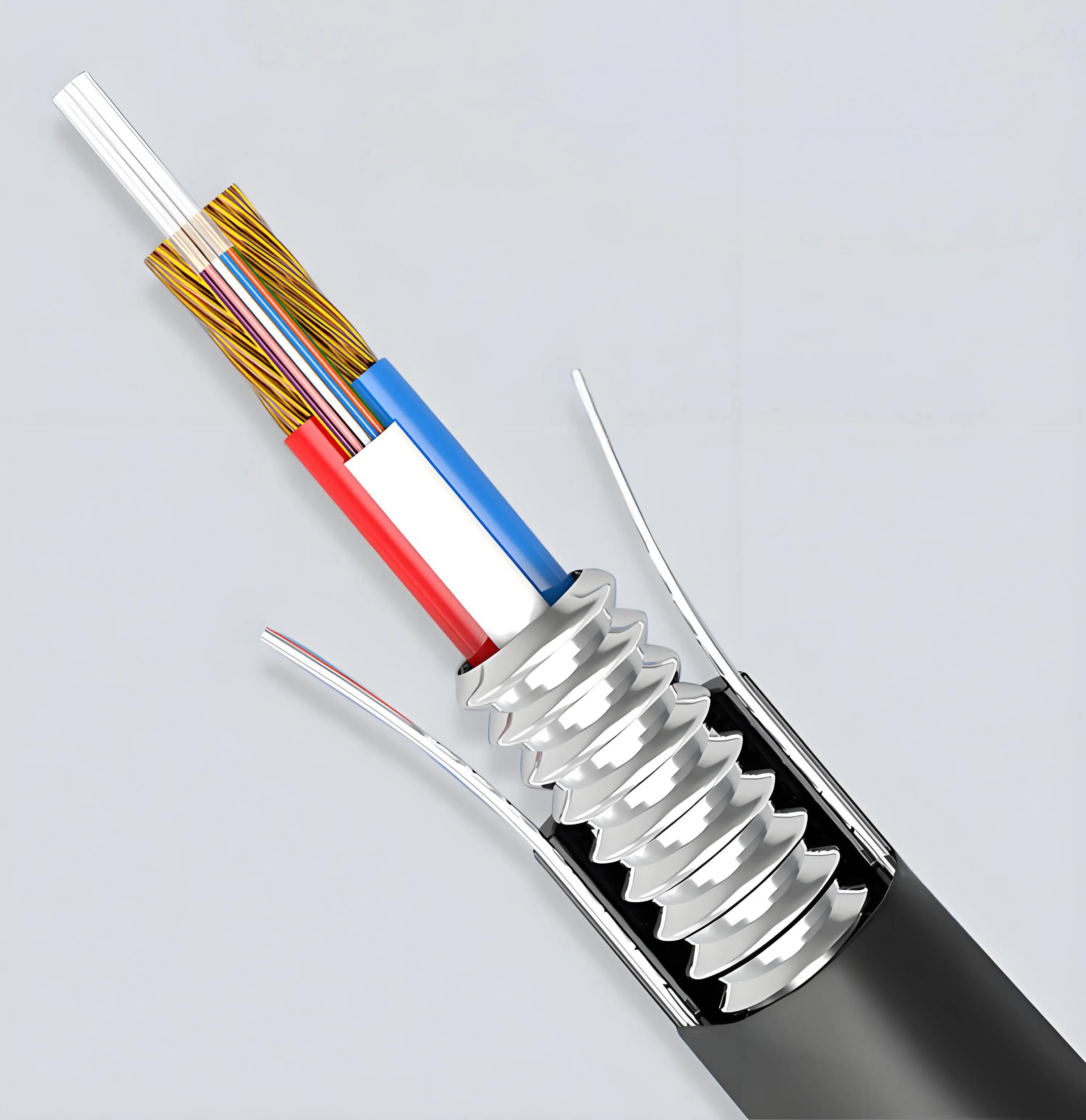
Designed for outdoor use, Outdoor Fiber Cables are communication lines where optical fibers are bundled into a core and shielded with protective sheaths. This construction, which often includes a rugged outer sheath, distinguishes them from indoor cables and is synonymous with the term "outside plant fiber optic cable."
The features of the outdoor optical cable :
Outdoor Fiber Cables are constructed with a core of hair-thin glass fibers, protective plastic sleeves, and a rugged outer jacket. Unlike metallic cables, they contain no valuable metals like copper or aluminum, rendering them non-recyclable. Their key mechanical strengths—higher tensile strength, a thicker protective layer, and frequent armoring (e.g., a metal sheath)—make them ideal for inter-building and long-distance network connections.


