

 Español
 Português
 لالعربية
 Русский
 Bahasa Indonesia
 Français
 Türkçe
 Bahasa Melayu
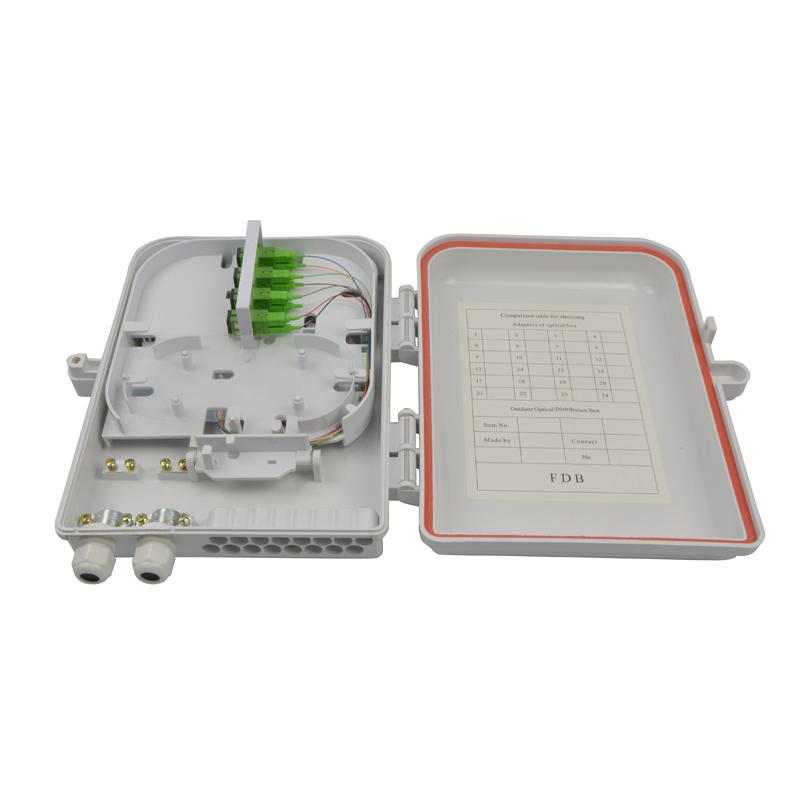
With the global proliferation of Fiber to the Home ( FTTH ) networks, the "last mile" of fiber optic cabling has become crucial. As a key node connecting the feeder cable and the drop cable, the Outdoor Termination Box (OTB) plays a central role in protecting fiber optic splices and distributing signals.
This article will delve into what an Outdoor Termination Box is, its core advantages, and the key factors to consider when choosing one.
What is an Outdoor Termination Box (OTB)?
An outdoor termination box (often called a fiber optic distribution box or outdoor terminal box) is an enclosed enclosure used in outdoor environments. Its main function is to terminate, protect, connect, and manage optical cables.
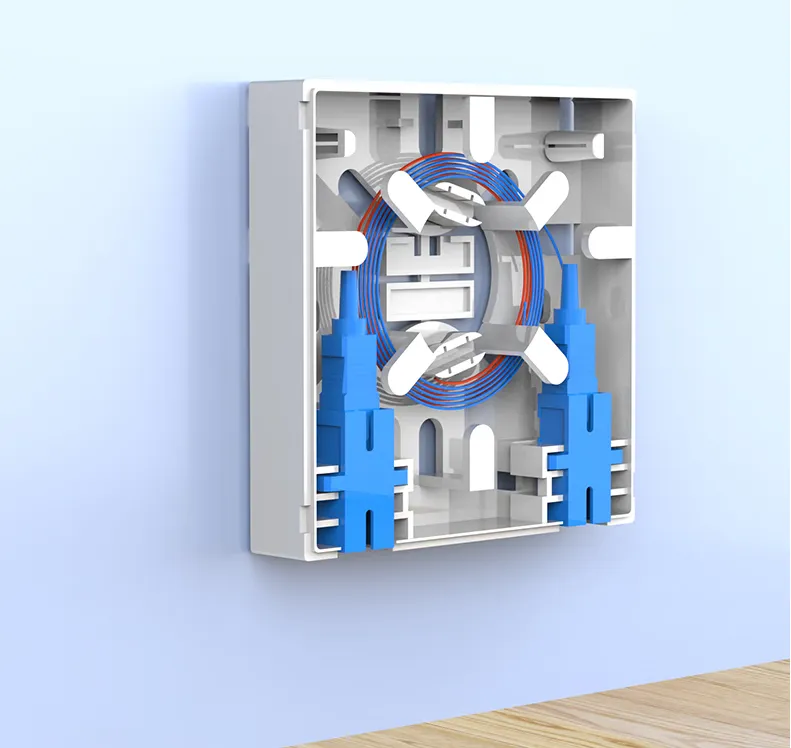
In an FTTH network architecture, an OTB (Optical Branch Terminal) is typically installed on a building wall or pole. Internally, it usually houses a fiber optic splice tray, fiber optic adapters, and a PLC (Plug-in Controller) splitter , distributing a single main fiber optic cable signal from the operator to multiple end users.
Four key features of a high-quality outdoor termination box
Because it is installed outdoors, an Outdoor Termination Box (OTB) must be able to withstand harsh environmental conditions. A high-quality Outdoor Termination Box must possess the following characteristics:
1. Excellent IP Rating
This is the most important indicator for outdoor equipment. A qualified OTB should at least meet the IP65 standard, while high-end products should meet IP68 .
Waterproof and dustproof: It must be able to completely prevent dust from entering and withstand water jets from all directions (rainproof).
Anti-UV: The outer casing material must contain UV-resistant components to prevent the plastic from aging, becoming brittle, or cracking under sunlight.
2. Durable material
High-strength engineering plastics are typically used, such as PC (polycarbonate) + ABS blends or SMC (sheet molding compound) .
Impact resistance: Able to withstand impacts from external hard objects (IK10 rating).
Corrosion resistant: It can resist the erosion of acid rain or salt spray (in coastal environments).
3. Flexible internal management design
A good OTB internal design should have clear hierarchical structure:
Dual-layer structure: The bottom layer is used for fiber optic splicing and fiber storage, while the top layer is used for wiring and branching.
Bending radius control: Ensure that the bending radius of the optical fiber is greater than 30mm when coiling to avoid signal loss.
Adapter compatibility: Compatible with various types of fiber optic adapters such as SC, LC, and FC.
4. Theft prevention and security
Equipped with a dedicated safety locking device to prevent unauthorized personnel from opening the enclosure and damaging the network connection.
Main application scenarios of Outdoor Termination Box
Depending on network size and deployment location, OTB has a wide range of applications:
FTTH (Fiber to the Home): A drop fiber optic cable installed on the exterior wall or stairwell of a residential building to connect home users.
FTTB (Fiber to the Building): Installed in the low-voltage wiring shaft or on the exterior wall of an office building, serving as the building's main wiring point.
ODN (Optical Distribution Network): A splitter node in a passive optical network.
Video surveillance transmission: Fiber optic access for outdoor security surveillance cameras.
Procurement Guide: How to Choose the Right OTB?
When purchasing an Outdoor Termination Box, please be sure to check the following parameter list to ensure that the product meets your project requirements:
| Factors to consider | Recommended standards/options |
| Port Capacity | Common configurations include 8-core, 12-core, 16-core, 24-core, and 48-core. A 10-20% redundancy capacity should be reserved. |
| Installation method | Wall Mount or Pole Mount? Make sure the accessory package includes the corresponding clamps or screws. |
| Splitter type | Does it need to be pre-installed with a PLC Splitter (such as a 1:8 or 1:16 box/tube splitter)? |
| Number of cable entry and exit holes | Check whether the number and size of the feeder inlet and drop outlet match the diameter of the optical cable. |
| Ease of use | Does the cover open to an angle greater than 120°? Is it easy for construction workers to operate? |
FAQ
Q: What is the difference between an Outdoor Termination Box and an Indoor Termination Box?
A: The main difference lies in the protection rating and materials. Outdoor models must be waterproof, dustproof, and UV resistant (IP65+), and made of more robust materials; while indoor models usually only need an IP30-IP40 rating, are smaller, and focus on aesthetics and portability.
Q: How many users can a 16-core OTB accommodate?
A: It depends on the network architecture. If it's a point-to-point connection, it supports a maximum of 16 users. If a 1:16 PLC splitter is placed inside the enclosure, it can also serve 16 FTTH users.
Summarize
Choosing a high-quality Outdoor Termination Box ( OTB) is the cornerstone of building a stable, long-life fiber optic network. Whether for dealing with extreme outdoor weather or for simplifying future network maintenance, investing in an IP65/68 compliant and well-designed OTB is a wise move.


