What are Fiber to Fiber Connectors? Types, Applications, and Selection Guide

2025-10-11

0.jpg

Snippet Optimization

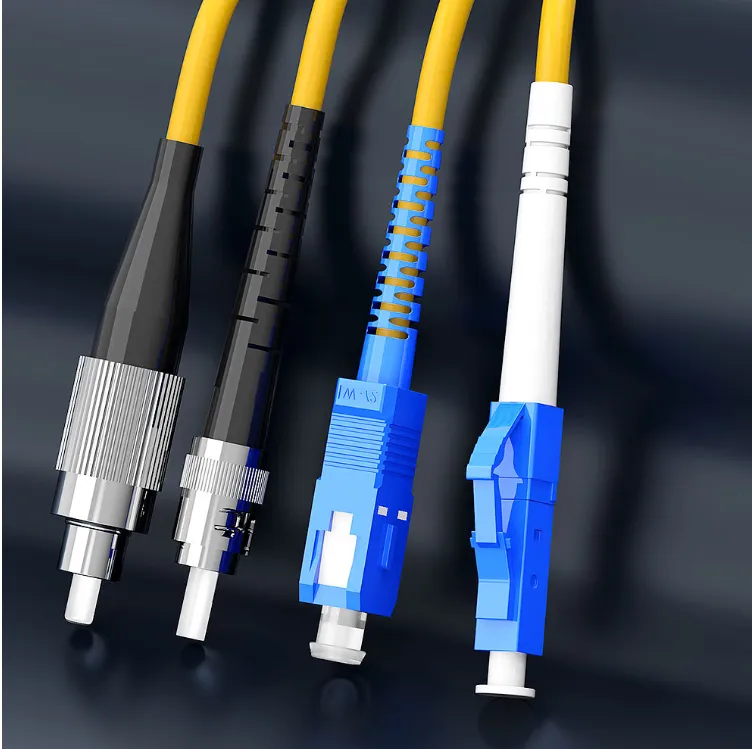
A fiber-to-fiber connector, also known as a cable connector or fiber splice, is a device used to permanently or temporarily connect optical fibers to enable efficient transmission of optical signals. It uses a high-precision ferrule and alignment sleeve to tightly align the end faces of two optical fibers, minimizing optical signal loss. Common types include LC, SC, and MPO/MTP , and are widely used in telecommunications, data centers, and enterprise networks.


1. The core role of fiber optic connectors

Fiber optic connectors are essential components in optical communication systems. They provide a fast, repeatable, and splice-free method for connecting and disconnecting fiber optic links. The connector's primary goal is to ensure precise alignment of the fiber cores, resulting in low insertion loss and high return loss , ensuring high-quality optical signal transmission.

2. Main fiber optic connector types

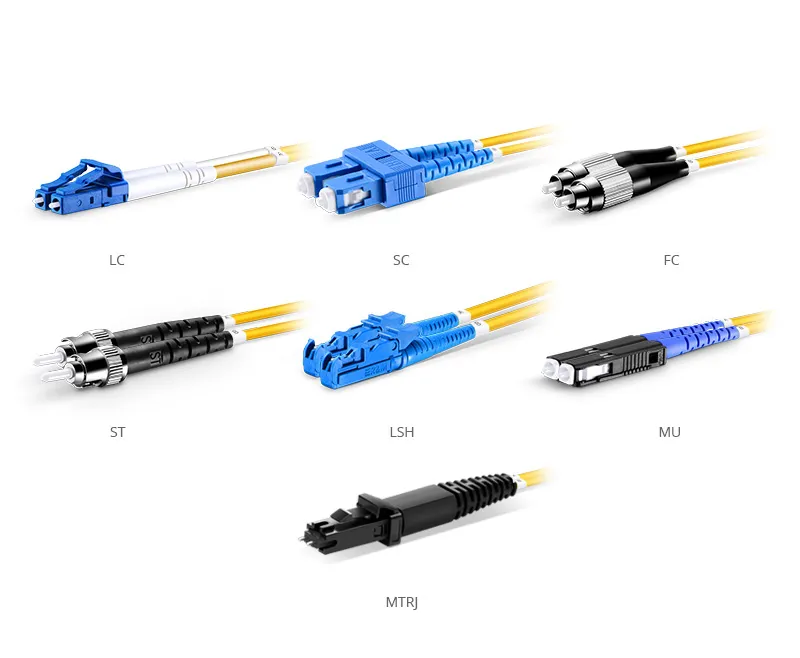
There are about a hundred types of fiber optic connectors on the market, but the most common and widely used ones are mainly the following:

Connector TypeKey FeaturesFerrule sizeTypical application scenarios
LC (Lucent Connector)Small Form Factor (SFF), Latch mechanism1.25 mmData center, high-density patch panel, SFP/SFP+   transceiver
SC (Subscriber Connector)Push-Pull mechanism, excellent performance2.5 mmTelecommunications networks, passive optical networks   (PON), point-to-point connections
ST (Straight Tip)

Bayonet connection, spring loaded

2.5 mmEarly multi-mode applications, enterprise networks, and   military applications
MPO/MTP (Multi-fiber Push On)Multi-fiber (4 to 144 cores), high-density designN/AUltra-high-density data centers, 40G/100G/400G parallel   optical transmission


20240718102421cvzawn.jpg


3. Connector polish type

The end face polish of fiber optic connectors is a key factor affecting performance and is mainly divided into three categories:

  • PC (Physical      Contact) : The end face is      slightly convex to reduce the air gap.
  • UPC (Ultra      Physical Contact) : Has a finer      finish than PC and higher return loss (less signal reflection).
  • APC (Angled      Physical Contact) : The endface      is polished at an 8-degree angle. This is the best choice for achieving      extremely low return loss (>60 dB) and is often used in single-mode      applications with extremely high reflection requirements, such as CATV and      FTTX.


4. How do I choose the right fiber optic connector?

Choosing the right fiber optic connector requires considering the following factors:

  1. Density  requirements : In high-density  environments (such as data centers), LC (smallest size) and MPO/MTP (multi-fiber) are preferred.
  2. Network Type : Telecom and PON networks often use SC and APC polished connectors.
  3. Fiber Mode :
    • Single-Mode : The core diameter is thin (about 9 μm ), suitable for long-distance transmission, usually with UPC or APC polishing.
    • Multi-Mode : Core diameter is 50 μm or 62.5 μm , suitable for short-distance transmission, usually with PC or UPC polishing.
  4. Frequency of  connection and disconnection : The push-pull/snap-on design of LC and SC provides quick connection capability.


in conclusion

Fiber optic connectors are the foundation of modern high-speed networks. With the continuous growth of data traffic and the increasing density of data centers, LC and MPO/MTP connectors are becoming industry standards. Understanding the characteristics and applications of different connectors is key to designing, deploying, and maintaining efficient fiber optic networks.


Q&A

Q: What is the main function of a fiber optic connector?

A: Its primary function is to terminate the ends of optical fibers and enable faster connections and disconnections than fusion splicing, ensuring efficient and accurate transmission of optical signals between two optical fibers.


Q: What is the core component of a fiber optic connector? What is its function?

A: The core component is the ferrule. It is a cylindrical structure that secures the optical fiber and ensures precise alignment of the fiber cores, allowing light to pass smoothly.


Q: What are the common types of fiber optic connectors on the market?

A: Common connector types include SC (square), LC (low profile), ST (bayonet), and MTP/MPO.


Q: Why do fiber optic connections require higher precision than cable connections?

A: Because optical fibers transmit light pulses rather than electrical signals, connectors must perfectly align the two tiny glass or plastic fiber cores to minimize optical signal loss (insertion loss).


Q: What applications are fiber optic connectors commonly used in?

 A: They are widely used in telecommunication switching offices, data centers, computer networks, fiber-to-the-home (FTTH), cable television (CATV) networks, and various sensors and industrial applications.


Product Inquiry

We use cookie to improve your online experience. By continuing to browse this website, you agree to our use of cookie.

Cookies

Please read our Terms and Conditions and this Policy before accessing or using our Services. If you cannot agree with this Policy or the Terms and Conditions, please do not access or use our Services. If you are located in a jurisdiction outside the European Economic Area, by using our Services, you accept the Terms and Conditions and accept our privacy practices described in this Policy.
We may modify this Policy at any time, without prior notice, and changes may apply to any Personal Information we already hold about you, as well as any new Personal Information collected after the Policy is modified. If we make changes, we will notify you by revising the date at the top of this Policy. We will provide you with advanced notice if we make any material changes to how we collect, use or disclose your Personal Information that impact your rights under this Policy. If you are located in a jurisdiction other than the European Economic Area, the United Kingdom or Switzerland (collectively “European Countries”), your continued access or use of our Services after receiving the notice of changes, constitutes your acknowledgement that you accept the updated Policy. In addition, we may provide you with real time disclosures or additional information about the Personal Information handling practices of specific parts of our Services. Such notices may supplement this Policy or provide you with additional choices about how we process your Personal Information.


Cookies

Cookies are small text files stored on your device when you access most Websites on the internet or open certain emails. Among other things, Cookies allow a Website to recognize your device and remember if you've been to the Website before. Examples of information collected by Cookies include your browser type and the address of the Website from which you arrived at our Website as well as IP address and clickstream behavior (that is the pages you view and the links you click).We use the term cookie to refer to Cookies and technologies that perform a similar function to Cookies (e.g., tags, pixels, web beacons, etc.). Cookies can be read by the originating Website on each subsequent visit and by any other Website that recognizes the cookie. The Website uses Cookies in order to make the Website easier to use, to support a better user experience, including the provision of information and functionality to you, as well as to provide us with information about how the Website is used so that we can make sure it is as up to date, relevant, and error free as we can. Cookies on the Website We use Cookies to personalize your experience when you visit the Site, uniquely identify your computer for security purposes, and enable us and our third-party service providers to serve ads on our behalf across the internet.

We classify Cookies in the following categories:
 ●  Strictly Necessary Cookies
 ●  Performance Cookies
 ●  Functional Cookies
 ●  Targeting Cookies


Cookie List
A cookie is a small piece of data (text file) that a website – when visited by a user – asks your browser to store on your device in order to remember information about you, such as your language preference or login information. Those cookies are set by us and called first-party cookies. We also use third-party cookies – which are cookies from a domain different than the domain of the website you are visiting – for our advertising and marketing efforts. More specifically, we use cookies and other tracking technologies for the following purposes:

Strictly Necessary Cookies
These cookies are necessary for the website to function and cannot be switched off in our systems. They are usually only set in response to actions made by you which amount to a request for services, such as setting your privacy preferences, logging in or filling in forms. You can set your browser to block or alert you about these cookies, but some parts of the site will not then work. These cookies do not store any personally identifiable information.

Functional Cookies
These cookies enable the website to provide enhanced functionality and personalisation. They may be set by us or by third party providers whose services we have added to our pages. If you do not allow these cookies then some or all of these services may not function properly.

Performance Cookies
These cookies allow us to count visits and traffic sources so we can measure and improve the performance of our site. They help us to know which pages are the most and least popular and see how visitors move around the site. All information these cookies collect is aggregated and therefore anonymous. If you do not allow these cookies we will not know when you have visited our site, and will not be able to monitor its performance.

Targeting Cookies
These cookies may be set through our site by our advertising partners. They may be used by those companies to build a profile of your interests and show you relevant adverts on other sites. They do not store directly personal information, but are based on uniquely identifying your browser and internet device. If you do not allow these cookies, you will experience less targeted advertising.

How To Turn Off Cookies
You can choose to restrict or block Cookies through your browser settings at any time. Please note that certain Cookies may be set as soon as you visit the Website, but you can remove them using your browser settings. However, please be aware that restricting or blocking Cookies set on the Website may impact the functionality or performance of the Website or prevent you from using certain services provided through the Website. It will also affect our ability to update the Website to cater for user preferences and improve performance. Cookies within Mobile Applications

We only use Strictly Necessary Cookies on our mobile applications. These Cookies are critical to the functionality of our applications, so if you block or delete these Cookies you may not be able to use the application. These Cookies are not shared with any other application on your mobile device. We never use the Cookies from the mobile application to store personal information about you.

If you have questions or concerns regarding any information in this Privacy Policy, please contact us by email at . You can also contact us via our customer service at our Site.